Introducing Trustworthy Contact Updates

Introducing Trustworthy Contact Updates

Nudging utility customers to maintain accurate contact information across web and IVR

Nudging utility customers to maintain accurate contact information across web and IVR

A senior-level product design case study focused on improving customer outreach, regulatory compliance, and operational confidence by enabling secure, self-service contact updates across channels and operating companies.

A senior-level product design case study focused on improving customer outreach, regulatory compliance, and operational confidence by enabling secure, self-service contact updates across channels and operating companies.

Role: Senior Product Designer (hands-on lead)
Scope: Web + IVR omnichannel reconnection experience
Partners: Product, Business, Engineering, Legal, Regulatory

Business Context

Business Context

Customers were missing critical communications due to outdated contact information, leading to safety risks, higher support costs, and eroded trust.

Returned mail

Undeliverable email

Compliance risk

Goal

Introduce a scalable, self-service way for customers to update contact information—reducing failed outreach while ensuring accuracy, compliance, and consistency across web and IVR.

Primary driver
  • Inaccurate contact information causing failed outreach and regulatory risk
Secondary driver
  • Regulatory notification requirements
  • Inconsistent data handling across operating companies and channels

The Problem

The Problem

Customers could update contact information, but only through fragmented, error-prone paths that varied by channel, operating company, and account configuration.

Key Challenges

Key Challenges

Multiple Data Levels

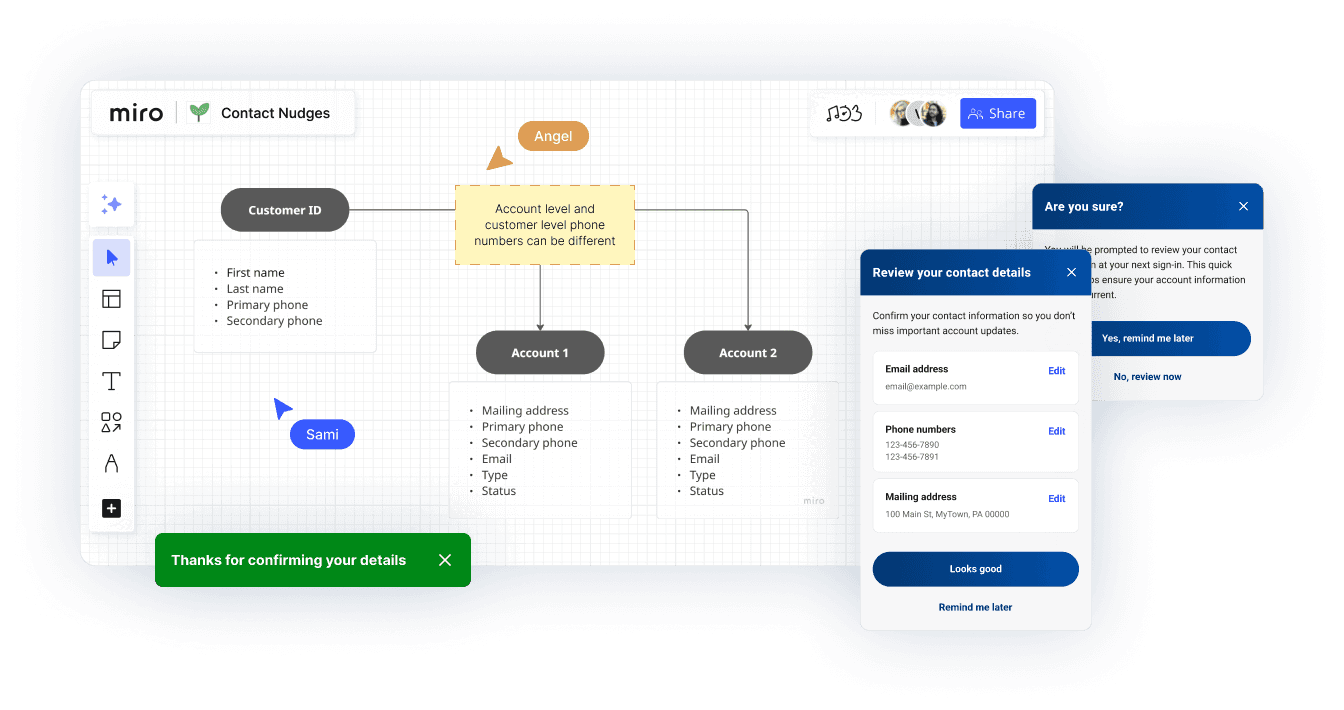
Contact information could exist at both the customer and account level

Contact information could exist at both the customer and account level

Contact information could exist at both the customer and account level

Customers had no visibility into which level they were updating

Customers had no visibility into which level they were updating

Customers had no visibility into which level they were updating

Operating Company Differences

Phone and email rules varied by state and OpCo

Phone and email rules varied by state and OpCo

Phone and email rules varied by state and OpCo

Some allowed multiple emails or phones; others did not

Some allowed multiple emails or phones; others did not

Some allowed multiple emails or phones; others did not

Accounts Without Online Profiles

Customers could have valid contact data even without a web account

Customers could have valid contact data even without a web account

Customers could have valid contact data even without a web account

Agent updates didn’t always map cleanly to digital experiences

Agent updates didn’t always map cleanly to digital experiences

Agent updates didn’t always map cleanly to digital experiences

The Result

Customers unknowingly updated the “wrong” data, agents corrected it later, and the system quietly drifted back into inconsistency.

Design Strategy

Design Strategy

Because this was a net-new self-service capability touching regulated data, the strategy focused on creating shared logic that could scale safely—balancing customer clarity, operational trust, and regulatory constraints.

System clarity

Abstracted complex data hierarchies into clear, step-by-step update flows

Abstracted complex data hierarchies into clear, step-by-step update flows

Abstracted complex data hierarchies into clear, step-by-step update flows

Removed the need for customers to understand customer vs. account-level distinctions

Removed the need for customers to understand customer vs. account-level distinctions

Removed the need for customers to understand customer vs. account-level distinctions

Channel-agnostic design

Defined contact update logic once and shared it across web and IVR

Defined contact update logic once and shared it across web and IVR

Defined contact update logic once and shared it across web and IVR

Allowed each channel to express the same rules using its own affordances

Allowed each channel to express the same rules using its own affordances

Allowed each channel to express the same rules using its own affordances

Clarity under stress

Treated contact updates as trust-sensitive moments, not routine form edits

Treated contact updates as trust-sensitive moments, not routine form edits

Treated contact updates as trust-sensitive moments, not routine form edits

Used progressive disclosure and plain language to reduce confusion and error

Used progressive disclosure and plain language to reduce confusion and error

Used progressive disclosure and plain language to reduce confusion and error

Each principle reflects deliberate tradeoffs between customer flexibility, operational risk, and regulatory requirements.

Navigating Complexity

Navigating Complexity

Updating contact information touched nearly every system boundary: customer identity, account hierarchy, channel ownership, and regulatory rules.

Progress depended on alignment more than pixels.

Balancing flexibility with guardrails

I facilitated working sessions with Product, Engineering, and Business stakeholders to map data ownership, update paths, and failure scenarios—aligning on which rules were non-negotiable and where flexibility could safely exist.

Shared logic across web and IVR

I partnered with web and IVR teams to define a shared, channel-agnostic decision framework, ensuring consistent outcomes while respecting different technical constraints.

Making requirements usable

I worked closely with Regulatory, Compliance, and Legal to translate requirements into plain language and validate customer understanding through usability testing.

Cross-Channel Process Alignment

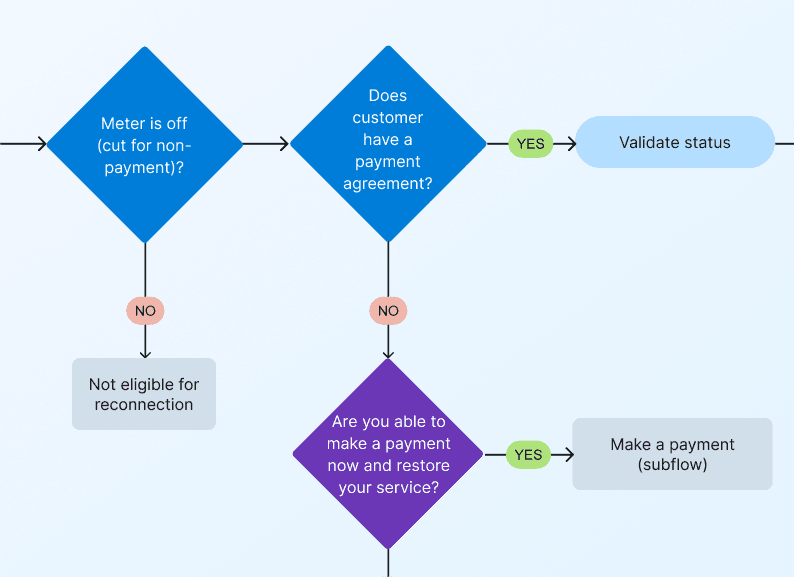
These flows translate complex, regulated decision logic into consistent customer journeys across web and IVR.

Rather than designing separate solutions per channel, the work focused on shared decision logic that could adapt to different interfaces without diverging in behavior.
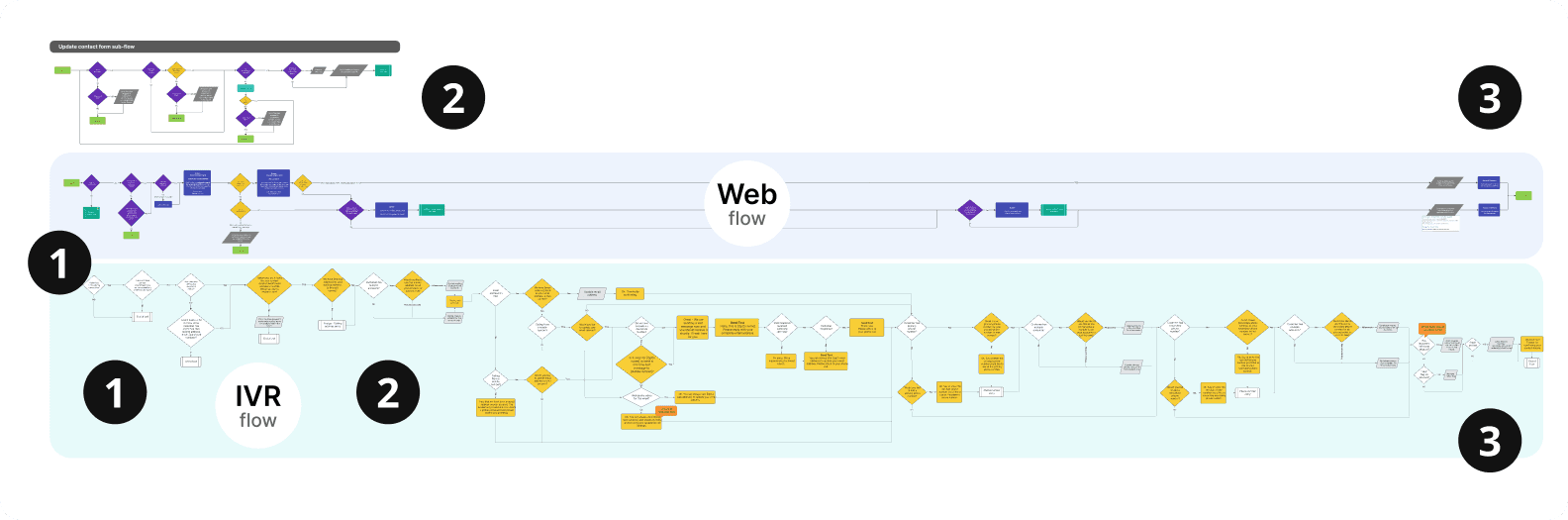
  1. Eligibility & data ownership

Determines which contact fields can be updated based on account linkage and profile status.
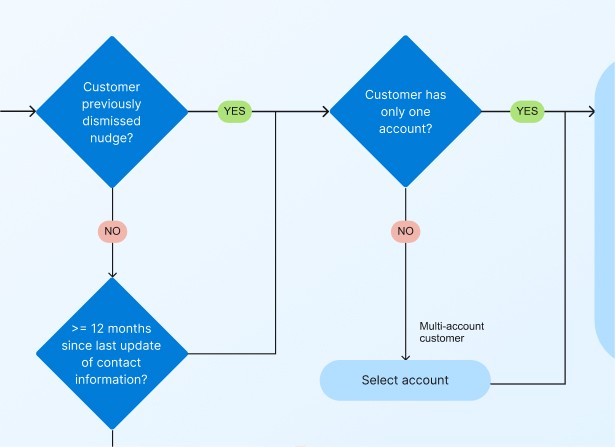
  1. Contact update paths

Routes updates to the correct data level without exposing internal structure to customers.
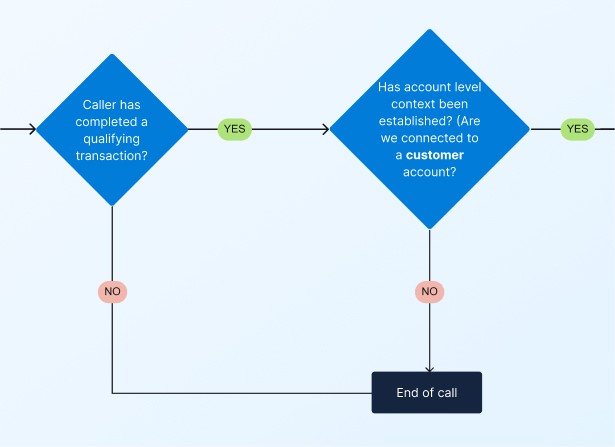
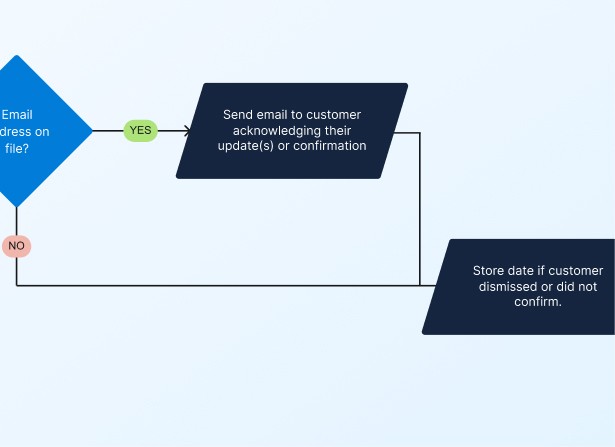
3. Confirmation

Ensures the customer receives confirmation and captures when contact information is not updated or explicitly confirmed.
Outcomes and Impact

Outcomes and Impact

Status: Delivered and in development across operating companies

Customer Impact

Italic text

Clear, guided contact updates

Customers update contact information without needing to understand internal data models

Italic text

Clear, guided contact updates

Customers update contact information without needing to understand internal data models

Italic text

Clear, guided contact updates

Customers update contact information without needing to understand internal data models

Italic text

Reduced confusion and rework

Fewer silent overwrites or mismatched updates across accounts

Italic text

Reduced confusion and rework

Fewer silent overwrites or mismatched updates across accounts

Italic text

Reduced confusion and rework

Fewer silent overwrites or mismatched updates across accounts

Italic text

Improved trust in digital channels

Clear confirmation of what was updated and where it applies

Italic text

Improved trust in digital channels

Clear confirmation of what was updated and where it applies

Italic text

Improved trust in digital channels

Clear confirmation of what was updated and where it applies
Validated through usability testing across multiple account and profile scenarios.

Validated through usability testing across multiple account and profile scenarios.

Validated through usability testing across multiple account and profile scenarios.

Business and Operational Impact

(Designed Outcomes)

Launched

Improved deliverability

Fewer returned mail pieces and undeliverable emails

Launched

Improved deliverability

Fewer returned mail pieces and undeliverable emails

Launched

Improved deliverability

Fewer returned mail pieces and undeliverable emails

Early indicators positive

Reduced agent correction

Less manual cleanup of mismatched contact data

Early indicators positive

Reduced agent correction

Less manual cleanup of mismatched contact data

Early indicators positive

Reduced agent correction

Less manual cleanup of mismatched contact data

Early indicators positive

Regulatory confidence

More reliable delivery of required customer communications

Early indicators positive

Regulatory confidence

More reliable delivery of required customer communications

Early indicators positive

Regulatory confidence

More reliable delivery of required customer communications

Early indicators positive

Scalable framework

Shared logic supports rollout across operating companies and future journeys

Early indicators positive

Scalable framework

Shared logic supports rollout across operating companies and future journeys

Early indicators positive

Scalable framework

Shared logic supports rollout across operating companies and future journeys

Reflection

This project reinforced that clarity in complex systems comes from aligning logic and constraints first—not screens.

By treating contact updates as a trust-sensitive system rather than a simple form, the work created a foundation that supports customers, operations, and compliance without sacrificing scalability.