Present Moments

Present Moments

As AI becomes increasingly embedded in digital products, designers face a new challenge: not how much intelligence to add, but when intelligence should remain quiet.

As AI becomes increasingly embedded in digital products, designers face a new challenge: not how much intelligence to add, but when intelligence should remain quiet.

This project is a conceptual exploration, not a production application.

Here, now.
Just breathe
Here, now.
Just breathe
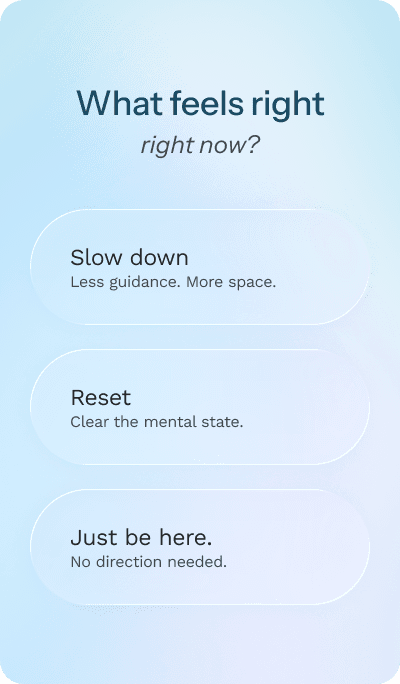
What feels right right now?
You can change this later.
What feels right right now?
You can change this later.

From an AI design perspective, this screen represents a conscious boundary.

This moment establishes consent before adaptation. Only after the user has chosen a direction does the system begin to quietly adjust pacing or guidance. The fork does not fragment, but signals that the system is responsive rather than directive.

What if an app didn’t try to improve the user—but instead met them where they are?

What if an app didn’t try to improve the user—but instead met them where they are?

The Problem

The interface offers three equally weighted directions: Slow down, Reset, or Just be here. No flashy features or recommendations. This avoids embedding value judgments and reinforces the idea that there is no “correct” way to arrive.

Design Principles

My guiding principles were built using constraints—not limitations, that protected the experience from becoming intrusive, performative, or overwhelming.

Restraint as an AI Design Feature

Intentional restraint prevents the experience from becoming intrusive or performative.

User Agency Over Automation

The system follows the users direction without labeling or defining their internal state.

Accessibility Through Low Cognitive Load

Reduced visual noise and predictable pacing help users stay present without effort.

Concept & AI Behavior

How the AI Learns

This project treats AI as a behavioral system, not an interpretive one.

The adaptive system is designed to observe patterns of interaction, not emotional states. This distinction is intentional.

Instead of attempting to interpret how a user feels, the AI focuses on:

Frequency of engagement

Duration of sessions

Preferences for guided vs. unguided moments

These signals allow the app to adapt its behavior while avoiding assumptions about the user’s internal experience.

This approach prioritizes respect and emotional safety over accuracy or prediction.

What the AI Does Not Do

Just as important as what the system does is what it explicitly avoids.

The AI does not:

Label or categorize emotional states

Diagnose stress, anxiety, or wellbeing

Push content to increase engagement

Use streaks, rewards, or gamification

Interpret disengagement as failure

Absence is treated as a valid outcome, not a problem to solve.

Key Design Decisions

Language That Does Not Instruct or Judge

Rather than telling users what to do or how they should feel, the app uses permissive, invitational phrasing. The goal is to remove any sense of obligation or performance from the experience.
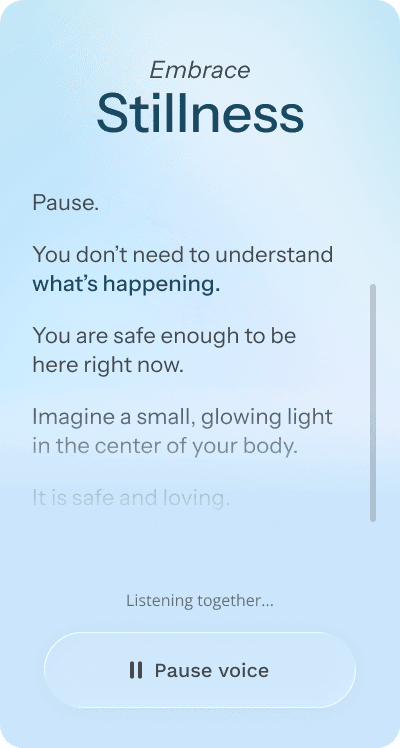
Silence as a First-Class Interaction

Silence is treated as a valid and intentional state, not a gap to be filled.

This decision supports emotional safety by allowing users to engage—or disengage—without feeling evaluated.

The Non-Intrusive Interface

Accessibility here is treated as emotional as well as functional, prioritizing clarity and softness over feature density.

Limited interactive elements

Clear primary actions

Gentle transitions

Outcomes & Reflection

This exploration intentionally avoids long-term personalization or metrics-driven optimization.

Developed a framework for designing AI behavior without emotional labeling or performance pressure

Explored how presence-focused experiences can exist without productivity metrics or engagement incentives

Applied accessibility thinking beyond compliance, focusing on cognitive and emotional load

Practiced translating abstract valuessuch as trust and safetyinto concrete product decisions

Previous case study
Previous case study
Previous case study